
Tuesday, May 11, 2010

Tuesday, December 15, 2009
Progress with Claire
Making Connections!
Although i consider Myself and Tom very well connected, i cannot speak so surely of our nitinol experiments! The thing about nitinol is, you cant really solder it, because its covered in enamel, which repels solder, and when you scrape it off the nitinol becomes brittle and snaps too easily. We did think of using a special crimp like the one manufactured by Dolphin in the US, but these aren't available anywhere else and regular crimps just wont cut the mustard (too big ad heavy). Crocodile clips are bad for testing because of their weight and hindrance to the movement of the nitinol, in fact the best connection we have made so far has been using alluminium foil. We plan to ask Di Mainstone how she made her connections when we interview her over skype in the new year, to solve this annoying yet crucial problem!
Conductive Thread..

There are many types of Conductive Thread, the one we have been experimenting with happens to be the thinnest. What we have discovered about this is that while the thread is fine for sending electronic signals along, it is absolutely hopeless at powering actuators through. So, after winding multiple threads together to see if it lowers the resistance (it doesnt) we have concluded that we need a thicker wire. The following video shows a little experiment to show its failures.

Here is a useful guide to Conductive thread, we plan on using the thickest available thread as it will not be shown externally. On Instructables.com there are some nice guides to making soft switches and weaving using conductive thread .


Kukkia and Vilkas
flowers and nitinol! However we want to achieve a more complex movement.
Di Mainstone
Sometime last year we spoke to Di Mainstone after her inspirational lecture at the university Newport about Nitinol. She gave us a brief overview of the material, and we have been using her work as a sort of nitinol how-to handbook. In the above video you can see her insulating the nitinol with glass beads. We have recently got our hands on some thicker nitinol that gets rather hot and so insulation may be a necessity, either using glass beads on points of articulation or coating the entire length of nitinol in silicon.
Although Di Mainstones work is very relevant to ours, her use of nitinol as an actuator is
nowhere near as realised as we hope Rhosynn to be. The movement induced via the nitinol
is small and subtle while we aim ours to be grand and total.
We can see here that Mainstone largely uses the spring formation of nitinol externally to achieve movement, we plan on using it internally. We have planned to interview Di Mainstone over skype with claire to ask a few logistical questions, like how she made connections with the nitinol to conductive thread.
Saturday, December 12, 2009
Further Rhosyn designs!

With the aid of Claire and her painting and drawing skills we put this together. I like the feel of this as it shows the two sides of the Rose the beauty of the red flower about to bloom and then the sharp spiky stork.
Paul Frank wearable Technology

Wednesday, December 9, 2009
Wearable Reasearch

The Giro Omen Audio is a skiing helmet that has built in speakers, This is interesting to me as it brings ideas for other uses like real time updates of the snow conditions, built in GPS that is connected to bad weather warnings in that particular area. If this was linked to a timing device you could get live splits read to you.
Monday, December 7, 2009
Mettings for Funding
Student Services:
Tuesday 7th December 3:30 pm
Jenny Hann (Head of the Department of Design)
Thursday 10th December 4:00 pm
Tuesday 7th December 3:30 pm
Jenny Hann (Head of the Department of Design)
Thursday 10th December 4:00 pm
Friday, December 4, 2009
Logo designs for Claires dress


The team decided we need to brand the dress if we are going to be looking for funding off the University or else where. the purpose is to have a logo which will reflect the dress and people will recognise it when seen on business cards, poster, flyers and websites. As you can see there are many roses on the logo as well as thorns to tie in with the theme. Rhosyn is the welsh word for Rose, this also seemed like a nice idea as it is being made in wales and will be shown for the first time in Wales.
Flexinol is a bit strange
After realising that we could not get enough power through a long length of nitinol with a 6volt battery we decided that proper calculations be made to determine exactly how much power we would need to power a certain length. To work this out we used good old Ohms law, which states that V= I X R, where V is Power, I is current and Ris resistance. The first step then is to measure the resistance of the nitinol - Not successful as the video below shows:
We decided to go with the figures printed on the Card that comes with a pack of flexinol for the values. Bizzarely it was concluded that the thicker the wire the less voltage required to power the nitinol. And if using nitinol of 375um, the maximum length you can power from a 9volt battery is 38cm. This link is a really good primer on nitinol calculations and even has some values to use in rough calculations. As a general rule for muscle wire for every centimetre you add 0.3 volts. which when tested was near true, but what we did learn from today was the fact that the thicker the wire the less amount of power it needs... which is the complete opposite to many other wires. So onwards we go, its better this way as it means less batteries and more movement.
Fabric Shopping in Cardiff with Claire
This was an interesting one for me, The fabric needs to be stiff enough to hold its own position upwards, then the flexinol will pull it down. It seems that the fabric we wanted to use was fair to expensive, so we are now looking to use products like blind stiffener to get the effect we want.
Materials with Michelle


We have been introduced to many new materials of a late, which isn't our fort-ay, its good to have influence on them though as its important to get the lighting correct for Michelles dress. the materials shown above are really nice and almost hide the LED but create awesome filters for the lights.
Meeting in Fashion
We have been meeting with the girls every week to keep on top of things, the dress we are making for Claire (fexinol moving the petals) is taking allot more time. The idea hasn't been done before and is very problematic. Its also costing allot of money, Myles has spent £200 on Arduinos and cables etc. and ive spent near £200 on Flexinol wire. Clare is also finding it difficult to fund the amount of material which is needed to make the dress. This is leaving us in a bit of a dilemma as the dress needs to be complete by May. We recently decided the only option we have is to look to get funding from the University, In the process to doing this we had a meeting with George Savva from www.ittakes7seconds.com (more information can be found here) who had recently sat in on a presentation Clare was participating in. He seems like a very genuine guy who has heaps of knowledge on how to get funding and build the idea into what it should be, a commercial benefactor for the University of Wales Newport. He gave us advice such as
Confidence in your idea is key
work in percentages
Ask for more money than you need, gives you space to make mistakes
(I will hand in the sheet with further details on it)
But overall he seems a very good link to have and is some one we will be dealing with in the future.
Confidence in your idea is key
work in percentages
Ask for more money than you need, gives you space to make mistakes
(I will hand in the sheet with further details on it)
But overall he seems a very good link to have and is some one we will be dealing with in the future.
Thursday, December 3, 2009
Milford Instruments
Made a phone call today to Milford Instruments as there the main Uk supplier for Flexinol, I spoke to Sue who is In charge of sales and she was very helpful, I explained that i was a student working on a project who is looking to buy a lot of Flexinol from them. I then asked if we would be able to have any free samples to which she said yes. This is brilliant as any saving at the moment is a huge bonus. I was also able to find out where they buy it from, which is dynalloy in America which is the company we were looking to deal with as there much cheaper. After discussing things sue said she would be willing to sell the Flexinol in bulk for a much cheaper price. Excellent news, another good link to have. It must be the christmas spirit :)
Sue @
Milford Instruments Ltd
Pointer Farm, Great North Road
Peckfield, South Milford
LEEDS LS25 5LH
Tel +44 1977 683665, Fax +44 1977 681465
Click here for link to website
Sue @
Milford Instruments Ltd
Pointer Farm, Great North Road
Peckfield, South Milford
LEEDS LS25 5LH
Tel +44 1977 683665, Fax +44 1977 681465
Click here for link to website
Progress...
After a discussion with Michelle and bringing up the ideas of LDR's (Light determined resisters) we soon reached the idea of dresses which communicate. Michelle was very keen on the idea as it added more meaning to her collection, We were pleased as it added a little more taste to the project. The fact that each dress will determine what the other will appear like is something very unique and is much more creative than just writing a specific set of instructions of on, off for the LED's.
Further Development for lighting, We now have the ability to control fading through the marvels of PWM! A lovely function offered by the arduino, using RGB leds we can use PWM to merge red, green and blue into any colour thanks to the way our eyes work, it does not really create a new colour but quickly turns on and off the 3 colours. Our eyes continue to see colour after it has disappeared through the phenomena of Persistence of vision, and thus creates the illusion of making a different colour.
Above shows the LED cube that Myles spent a whole lot of time soldering performing a neat little set that was found on the internet. The cube is under a piece of material which shows examples of shadow which adds so much to the aesthetics.

The above video shows the controllability the arduino offers to allow us to create different sequences with the LEDs which is a key factor for Michelles dress.
This is some of our first tests using very light material and small amounts of Flexinol. We use the oven as the source of heat as it much less fidly in comparison to setting up circuits to run a current through the wires to heat them up. The end result is good an as we hoped, the coiled piece of Flexinol returns to its new shape and folds the petal in the process.
Monday, November 16, 2009
Wiz bang

Myles and i have decided its about time we have a name to be recognised as. So from now on if your dealing with a certain Myles Leadbeatter and Tom wheeler your dealing with Wiz bang.
Check out our vimeo channel where you can see our working progress click here
Friday, November 13, 2009
LED Dress!!!
This is an amazing use of lEDS, a serous example of what you can create with timing and fade effects.
Myles and myself are creating similar effects but using a lot less lEDS.
Wednesday, November 11, 2009
Wearables-Good ideas with materials
Monday, November 9, 2009
Arduino
For both claire and Michelles dresses we are going to use the Arduino, our microcontroller of choice, in the battle against uninterfaced inputs and outputs! A major plus of deciding on arduino opposed to other controllers is that the Arduino comes in a format specifically aimed at wearables.... The Lillypad Arduino
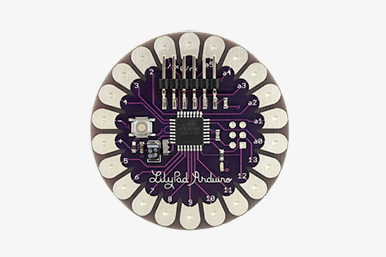
The Lillypad uses sowable tabs instead of female header pins and features the exact same number as on a standard arduino 328 board, as well as being a fraction of the size and washable!!!

A useful shop full of Arduino goodness click here
The Lilypad power supply.
Other Bonuses of using the Arduino Platform is that im familiar with the programming language and have experience working with it previously and there is a great deal of projects available open source should we need any direction or help with coding.
A useful shop full of Arduino goodness click here
Sunday, November 8, 2009
Future Technology that cant be ignored
Microsoft College Tour 2009
This reminds me of the interface used in the Iron man film. Mental to think that this stuff is working now, We have a crazy future ahead of us!
L Wire
Myles found this awesome step by step on implementing l wire in garments. This will be really handy when it comes to making Michelle's dress, We have decided we are going to test the idea of using l wire as well as LED's to get the overall atmospheric feel she is looking to achieve.
inspiration can be found from the deep seas.
Maker faire Wales / Eddo Stern Exhibition


Images above taken from ffotgallery.org link below
Myles and i as well as a few other students made the trip down to the Chapter gallery in Cardiff to check out some work. This was the first time i had been to a maker fair, It was brilliant. Loads of ideas and and just pure awesomeness, to see other people with the same interests making all these different types of technology was so new to me. We had a chat with most people there and learnt lots about their projects.
Video above of an audio visual by Kathy Hinde + TwitchR
Eddo sterns work was a delight to view, every thing from the actually Art its self to the finnish of his work was a real eye opener.
Eddo sterns work was a delight to view, every thing from the actually Art its self to the finnish of his work was a real eye opener.
MIT wearables
This video has made it apparent to us that there is a possible use for nitinol in not just fashion but perhaps in interior design as well, in conjuction with magnetic paint you could make a really beautiful installation . I am considering making a wall hanging for the exhibition in may that reacts to users.. more to come later.
Heres a little video made in london showing some nice but quite conventional techniques using nitinol that may be incorporated into an installation of some kind
Heres a little video made in london showing some nice but quite conventional techniques using nitinol that may be incorporated into an installation of some kind
Tuesday, October 20, 2009
Flexinol Testing
Today was straight up awesome! the muscle wire book and wing starter kit arrived and Myles and i got to it. We began by building the wing starter kit! was good fun and allowed us to see how easily it is to make some thing move using in this case very little amounts of Flexinol.
After this we started pondering about the idea of casting our own Flexinol shapes. We had a little read in the muscle wire book and it filled in the blanks, Flexinol can be cast into a shape at 300 degrees, an oven reaches 250 degrees which we decided was close enough and worth a try. It worked! after coming up with a way to hold the Flexinol in a coiled shape using a bolt and a few nuts we placed it in the oven for ten minutes on gas mark 9. We then let it cool for 5 minutes, the wire had stayed in the shape we wanted, Then we straightened it out and went on to putting it near some heat and like magic the Flexinol returned to its new shape of a coil..... satisfied.
Above is the Wing starter kit running
The video above shows Flexinol 150um in its standard form and how it reacts to heat after being scrunched up.
The video above shows how strong the Flexinol 100um wire is. Once heated the Flexinol returns to its newly formed coiled state and pulls the object up with it.
This is a clearer view of the Flexinol 100um wire doing its thing.
After this we started pondering about the idea of casting our own Flexinol shapes. We had a little read in the muscle wire book and it filled in the blanks, Flexinol can be cast into a shape at 300 degrees, an oven reaches 250 degrees which we decided was close enough and worth a try. It worked! after coming up with a way to hold the Flexinol in a coiled shape using a bolt and a few nuts we placed it in the oven for ten minutes on gas mark 9. We then let it cool for 5 minutes, the wire had stayed in the shape we wanted, Then we straightened it out and went on to putting it near some heat and like magic the Flexinol returned to its new shape of a coil..... satisfied.
Above is the Wing starter kit running
The video above shows Flexinol 150um in its standard form and how it reacts to heat after being scrunched up.
The video above shows how strong the Flexinol 100um wire is. Once heated the Flexinol returns to its newly formed coiled state and pulls the object up with it.
This is a clearer view of the Flexinol 100um wire doing its thing.
Monday, October 19, 2009
Problems with Flexinol
Myles and i have had our first tests in the electronic labs with the lovely stuff that is flexinol. The flexinol wire defiantly moves when you run a current through it but seems to as we describe it burn out after using it a few times. We understand that we are not experts with this material and have decided we need to learn much more about flexinol before we can move on.
I have just ordered a book explaining muscle wire as well as a starter kit to make wings move using flexinol, i hope this is beneficial and can teach us the basics to allow us to move on and make further progress with the material.
Video of experimenting in the lab to come.
I have just ordered a book explaining muscle wire as well as a starter kit to make wings move using flexinol, i hope this is beneficial and can teach us the basics to allow us to move on and make further progress with the material.
Video of experimenting in the lab to come.
Monday, October 12, 2009
More evidence that Nitinol is the way to go
Here is our new mission statement..
Current collaboration between Technology and fashion only displays technology as a simple appendage or tacced on fancy, opposed to a symbiotic integration. The Aim of our dress is to link technology with High Fashion so closely that each facet cannot survive without the other. We hope to create a technically accomplished piece of wearable technology born of aesthetics and Haute Couture.
Rhosyn
Rhosyn is an amalgamation of cutting edge technology and Haute Couture.
Created through innovation and multidisciplinary collaboration, Rhosyn is a pioneering and Avent Garde dress, designed to gracefully open and unfurl into a rose.
At the forefront of wearable technology research and development, Rhosyn combines technology and fashion design at the highest levels.
The design of Rhosyn aims to mimic a real rose, with a multitude of petals, created from the shape memory alloy, flexinol and fine silks.
Thursday, October 8, 2009
Capturing the moment!
This weekend i am hoping to sort out my video camera so i am able to document all of our work, that should make the research folder aka blog a lot more interesting.
Its ordered!
The Flexinol has just been ordered!
I ordered one of each width to find out which would work best in this project
On order are:
1 meter x 50um
1 meter x 100um
1meter x 150um
Tuesday, October 6, 2009
Nitinol = Flexinol
Myles found Nitinol for sale in the uk
It costs £8.00 Per meter
Below is example of nitinol in fabric, this is the closest thing i have seen to natural movement yet.
Thursday, October 1, 2009
Nitinol scares me...
Useful links:
www.talkingelectronics.comwww.shape-memory-alloys.com
I must admit that i have tried to stay clear of this stuff, some thing about heating metal near fabric just doesn't do it for me, but if we are to go about making this dress in the correct manner, to achieve the look and feel as natural as possible we may have to venture down this route.
It began with Di Mainstone coming to our University and showing her work, she did some brilliant lectures introducing great interactive elements with in her clothing. She had made items of clothing move using Nitinol ( Nickel +Titanium) example below
Another example of how it works
This is looking very close to some thing we are aiming for
How to make it into a certain shape then???
The video below touch's on it, need to research what temperatures and how easy it would be to
create custom shapes for Claire's Rose, is it to dangerous to attempt in the University?
Monday, September 28, 2009
Collaboration with the Fashion Students
Earlier in the week Myles and i had a meeting with two students who are studying fashion, Claire and Michelle are looking to include interactive elements with in there final year projects. This is very exciting as this could mean that our work will get to see a cat walk and final year show.
Claire has a wonderfully creative idea to make a dress which will blossom like a rose.
Example below:
Below you able to see Claires concept drawings for the dress, Claire has been very clearer
about the invisibility of the technology which will allow this dress to come to life. This makes
our job much harder as the technology used will have to be very small. This also means their
will be less space for what ever mechanism or solution we come up with to move.


Ideas on how to make such unique wearable technology has led to Myles and my self
scratching our heads.
scratching our heads.
What we could use?
Air / Helium:
Blow the dress up using similar techniques to blowing up an inner tube in a bicycle tyre.
This would have to incorporate some type of pump or air compressor which would have to
be attached to the dress. Air compressors equal noise as well as adding much unwanted weight, so this idea is becoming much less feasible. One more thing to note is the cost, a lot of the innertubes would have to be custom made and the air compressor's cost over £200.
Mechanical / Piston / Pulley system:
Using a motorized pulley to control cables which will be stitched into the dress's petals could bethe answer we are looking for. This idea is harder to explain but theory allot easier to actually
create.
Below are some mock ups and sketches:

With these ideas well on there way, we have another meeting with Claire on Thursday 1st October to further our research and share opinions on where this project is going.
The Idea is not to look like these guys....

And these guys...
Saturday, September 19, 2009
The Machine Stops
When i was in College Rob Smith a teacher of mine told the class of a short story written in 1909. Here is a beautifully made film based on it.
Monday, September 7, 2009
Back on Track Galleries
Just finished the back on track flash galleries, really pleased with how they came out. Its been awesome working with Rowan and Ross on this website and i look forward to more work like this.
Go check it out at www.back-on-track.org
Tuesday, August 18, 2009
Green and wifi Bus Stops

Monday, August 17, 2009
Welcome to Wheelzworks
This blog will be an add on to the website i am currently making!
This will have all my research for uni projects on it!
Fun!
Tom
This will have all my research for uni projects on it!
Fun!
Tom
Subscribe to:
Posts (Atom)
